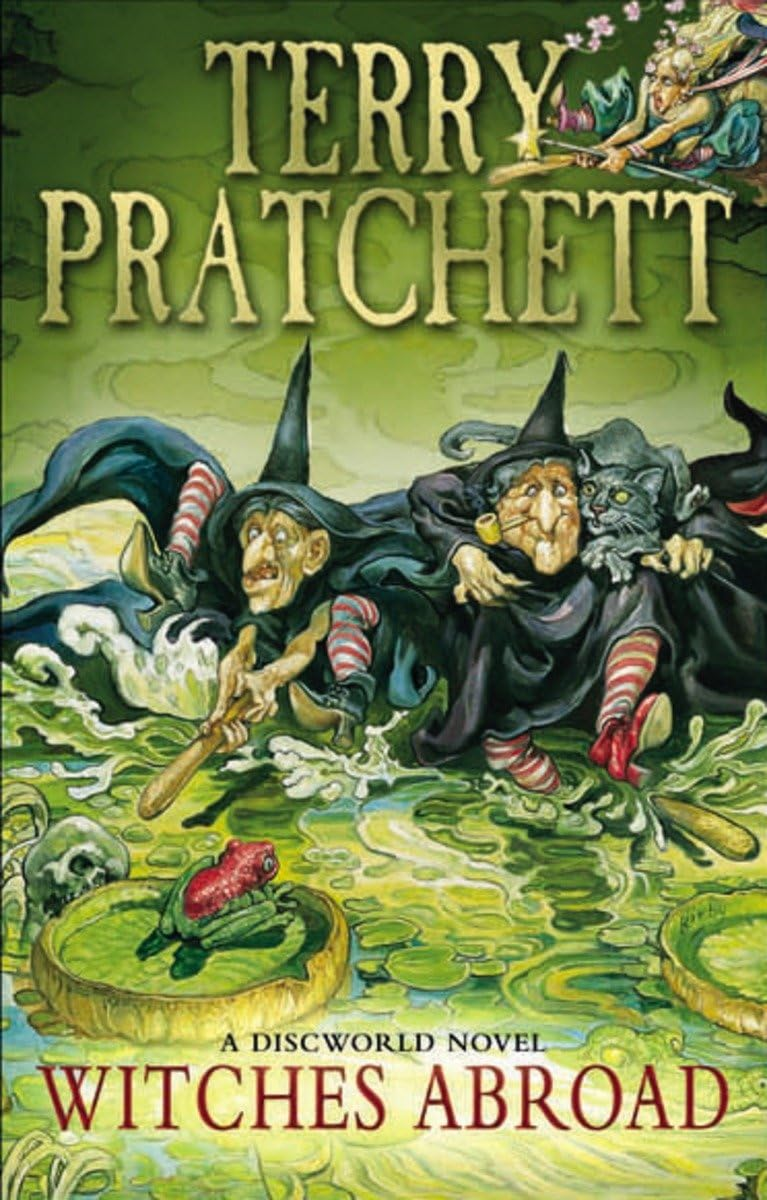
Witches Abroad
Final Thoughts
This one came at a very busy time so there was less discussion, regardless this was a fantastic book. So many complex themes and wonderful characters, so much magic, and absolutely hysterical at times.
This is, easily, an S-Tier Pterry book.
Summary
- The nature of Discworld reality
- Reality on the Disc is thin and can be bent by strong belief.
- Stories, when told and believed enough, carve grooves into reality, forcing life to follow their patterns — the theory of Narrative Causality.
- Examples: a prince can’t fail the quest his brothers died attempting; most evil witches meet oven‑related ends.
- Lilith’s plot in Genua
- Skilled magic‑users can deliberately shape stories.
- Lilith de Tempscire is remoulding all of Genua into a vast fairy tale.
- Central to her plan: marrying servant girl Ella to the Duc, the puppet ruler, on Samedi Nuit Mort at Mardi Gras’s end.
- Lilith, Ella’s “evil” fairy godmother, draws power from facing mirrors, which amplify magic and let her spy through any reflective surface.
- Ella’s second godmother
- Ella also has Desiderata Hollow, a “good” godmother living in Lancre.
- Dying, Desiderata leaves her magic wand (prone to turning things into pumpkins) to Magrat Garlick of the Lancre coven (with Nanny Ogg and Granny Weatherwax).
- Desiderata’s will instructs Magrat to go to Genua and stop the marriage; Granny and Nanny insist on coming.
- The journey begins
- They pass through the Copperhead dwarf mines, meet a Gollum‑like creature, and narrowly survive a waterfall plunge.
- Crossing into gloomy Überwald, Greebo the cat kills a vampire bat, freeing a city from its tyranny.
- Down the Vieux River
- They board a giant riverboat.
- Nanny gambles away all their supplies; Granny wins them back with magic.
- They disembark before cheated gamblers can retaliate.
- In a foreign village, they avoid being caught in a traditional bull stampede.
- Signs of warped stories
- Nearing Genua, Granny hints she knows something.
- They find:
- a castle asleep for ten years,
- an old woman living alone,
- a wolf forced into a twisted Red Riding Hood tale, which they end.
- Magrat asks why the stories exist; Granny says, “Practice.”
- Lilith strikes from afar
- In her hall of mirrors, Lilith targets them with tales, e.g. a Wizard of Oz–style farmhouse hurled at Nanny — foiled by her hat’s willow reinforcement.
- Arrival in Genua
- After an argument, they split up.
- Granny learns bizarre laws enforcing story roles (toy makers must whistle, innkeepers must be jolly).
- Granny and Nanny reunite, meet voodoo witch Mrs Gogol and her zombie helper Saturday.
- Granny admits Lilith is her sister.
- Magrat meets Ella
- Ella outlines the wedding plan and Mardi Gras timing.
- Her “stepsisters” attack; Granny spots they’re snake‑women made by Lilith and tricks them.
- Granny identifies Cinderella as the dominant tale.
- Sabotaging the ball
- Magrat breaks into the palace, destroys Ella’s dress.
- Nanny gets the coachmen drunk.
- Magrat turns the coach into a pumpkin; Lilith reverses it, using mice for coachmen and horses.
- The witches fly ahead, turn Greebo into a human, and send him to halt the coach — he gleefully attacks the drivers.
- Mrs Gogol’s giant cockerel, Legba, leads Ella to the swamp.
- Ella insists on going to avoid being hunted; Granny disguises and hypnotises Magrat as Ella, filling her with confidence.
- Inside the palace
- Magrat (as Ella) dances with the Duc.
- Granny and Nanny find the Duc’s “bedroom” — a pond; he’s a frog in human guise, needing water as his morphic field weakens.
- If Magrat kisses him, he’ll be permanently human and under Lilith’s control.
- Spell on Magrat ends at midnight; they race to make the clock strike sooner.
- Swamp moves toward the ball
- Mrs Gogol empowers Saturday; she, Saturday, and Ella head for the palace.
- Nanny (with Casanunda) speeds the clock.
- Magrat reverts to herself and flees, losing one slipper.
- Granny smashes it, but the snake‑women capture her and take the other.
- Lilith starts a slipper test; Nanny points out multiple fits — it fits her perfectly.
- Imprisonment and breakout
- Lilith throws the witches in the dungeon; Casanunda frees them.
- Snake‑women attack; Greebo kills them, then visits the kitchens where Mrs Pleasant feeds him.
- Showdown at the palace
- Saturday confronts Lilith, immune to her magic.
- She draws in all her power, turning the Duc back into a frog; Saturday crushes him.
- Greebo reverts to a cat.
- Revelations and clash with Mrs Gogol
- Saturday was Genua’s original ruler; Ella is his daughter and heir.
- Mrs Gogol, his lover, wants him restored despite being dead.
- She attacks Granny with voodoo; Granny defeats her with headology.
- Mrs Gogol retreats to prepare Ella’s coronation.
- Saturday is taken by Death.
- Final battle with Lilith
- Witches follow her into her mirror room.
- Lilith vows to restart the tale.
- Granny smashes a mirror, unbalancing the setup; Lilith escapes into it, Granny follows and loses her mind inside.
- In the mirror world, Death tells them they can leave only by choosing their true self.
- Granny chooses instantly; Lilith cannot and is trapped forever.
- Granny escapes; the mirror room is destroyed.
- Aftermath
- They stay for Ella’s coronation and Mardi Gras’s end.
- Flying home, they decide to see more of the world on the way.
Quotes
References
- Terry writes: “This may or may not already be an annotation somewhere, but Genua is a ‘sort of’ New Orleans with a ‘sort of’ Magic Kingdom grafted on top of it. It had its genesis some years ago when I drove from Orlando to New Orleans and formed some opinions about both places: in one, you go there and Fun is manufactured and presented to you, in the other you just eat and drink a lot and fun happens.”
- “Her name was Lady Lilith de Tempscire, […]” Tempscire is actually a French transliteration of Weatherwax.
- “The author, Grand Master Lobsang Dibbler, had an address in Ankh-Morpork.” This is yet another incarnation of Cut-Me-Own-Throat Dibbler, the Ankhian entrepreneur we learn much more about in Moving Pictures, and who also appears in Small Gods as the Omnian businessman Dhblah. Also, the name is a direct reference to Tuesday Lobsang Rampa, who was one of our world’s more successful psychic hoaxers: actually named Cyril Hoskin, and son of a Devon plumber, Lobsang Rampa claimed to be a Tibetan monk with paranormal powers. He wrote the best-selling 1956 book The Third Eye which, even though Rampa was exposed as a fraud by Time Magazine in 1958, is still being printed and sold as the real thing 50 years later. Rich, gullible people such as actress Shirley MacLaine still pay money to have their ‘third eye’ opened up by contemporary Rampa equivalents.
- “The witches flew along a maze of twisty little canyons, all alike.” This refers back to a legendary message that appeared in Crowther & Woods’ text adventure game ADVENT (see also the annotation for p. 114 of The Colour of Magic ): “You are in a maze of twisty little passages, all alike.” Many games have included variants of this. It also appeared in Zork (“The second of the great early experiments in computer fantasy gaming”, as The New Hacker’s Dictionary describes it), and in the Hitch Hiker’s Guide to the Galaxy game you appear in your own brain, in “a maze of twisty synapses”.
- The invisible runes, creature whose birthday it is, and “open up you little sods” are all a reference to Lord of the Rings.
- “‘Thank goodness witches float.'” An obvious joke, but easily missed: refers to ducking suspected witches. If they drowned, they were innocent.
- “[…] she wants to make it a Magic Kingdom, a Happy and Peaseful place […]! The most famous part of the Walt Disney World theme park in Orlando, Florida, is officially called the ‘Magic Kingdom’.
- “[…] Samedi Nuit Mort, the last night of carnivale, […]” Samedi Nuit Mort = Saturday Night Dead, a reference to the television comedy show Saturday Night Live.
- We learn about Black Aliss who appears to be the evil witch from ALL fairy tales.
- “Are you the taxgatherers, dear?’ ‘No, ma’am, we’re –‘ ‘– fairies,’ said Fairy Hedgehog quickly.” This is a Blues Brothers reference: in the film, the dialogue goes: “‘Are you the police?’ ‘No, ma’am, we’re musicians.'”
- “‘[…] and no one doesn’t get burned who sticks their hand in a fire.'” I feel that in Witches Abroad Terry was experimenting much more than usual with the literary device of foreshadowing. This is only one of the many instances in the book where something is said that means nothing to the reader first time around, but which suddenly becomes very significant when you notice it during a re-read, and you already know what is going to happen later.
- “‘What some people need,’ said Magrat, […], ‘is a bit more heart.’ ‘What some people need,’ said Granny Weatherwax, […], ‘is a lot more brain.’ […] What I need, thought Nanny Ogg fervently, is a drink.” These are The Wizard of Oz references to the Tin Man, Scarecrow and Lion respectively, once you remember that an alcoholic drink is also known as ‘Dutch courage’. In fact, in the original book the courage the Lion is given comes in a bottle, and many feel that Baum had alcohol in mind when he wrote it.
- “‘My full name’s Erzulie Gogol,’ said Mrs Gogol. ‘People call me Mrs Gogol.'” This resonates with In the Heat of the Night (see the annotation for p. 277 of Men at Arms ), in so much as we have two persons of the same profession, one of them black, the other white, and one of them way out of her territory. The name ‘Erzuli’ comes directly from Voodoo religion. Maîtresse Erzulie (also known as Ezili) is the ideal figure of womanhood, and the spirit of love and beauty.
- “So he said ‘Get me an alligator sandwich — and make it quick!'” “It is (I hope) obvious that Granny Weatherwax has absolutely no sense of humour but she has, as it were, heard about it. She has no grasp of how or why jokes work — she’s one of those people who say “And then what happened?” after you’ve told them the punchline. She can vaguely remember the one-liner “Give me an alligator sandwich — and make it snappy!” but since she’s got no idea of why it’s even mildly amusing she gets confused… all that she can remember is that apparently the man wants it quickly.”
- “‘I am called Saturday.’ ‘Man Saturday, eh?’ said Nanny Ogg.” Nanny is thinking of Man Friday as in Robinson Crusoe’s native friend. But Saturday is of course none other than Baron Samedi (Samedi = Saturday), the Voodoo keeper of cemeteries and lord of zombies. He appears as a skeleton wearing a top hat and a black cane.
- Casanunda, “the world’s greatest lover”, refers to our world’s Casanova. Notice that Casanova is often roughly pronounced as ‘Casanover’ (emphasis on the ‘over’), and that Casanunda (emphasis on the ‘unda’) is a dwarf…
- “Nanny Ogg’s voyages on the sea of intersexual dalliance had gone rather further than twice around the lighthouse, […]” A popular way of staving off boredom at typical British seaside holiday resorts is to take a trip in a small boat, which will often journey out as far as the local lighthouse and circumnavigate it. Hence the above colloquialism, implying that Nanny’s experiences were not limited to the inshore waters of male/female relationships.
- “But they went the long way, and saw the elephant.” Several people were immediately reminded of Fritz Leiber’s Hugo award winning novelette Gonna Roll The Bones, which ends: “Then he turned and headed straight for home, but he took the long way, around the world.” Terry has said there is no conscious connection, however. “Seeing the elephant” also resonates nicely with The Lord of the Rings, where Bilbo complains wistfully that he never got to see an elephant on his adventures ‘abroad’: “[…] Aragorn’s affairs, and the White Council, and Gondor, and the Horsemen, and Southrons, and oliphaunts — did you really see one, Sam? — and caves and towers and golden trees and goodness knows what besides. I evidently came back by much too straight a road from my trip. I think Gandalf might have shown me round a bit.” Also, “to have seen the elephant” is British military slang dating back to the 19th century, and means to have taken part in one’s first battle, while during the 1849 California Goldrush, “going to see the elephant” was widely used as a phrase by people to signify their intention to travel westwards and try their luck. (See e.g. JoAnn Levy’s 1999 book They Saw the Elephant: Women in the California Gold Rush.)
Leave a Reply