Small Gods
Final Thoughts
Another busy one but this was a really interesting book honing in on Pterry’s idea of faith as an energy source for gods. Really funny, although Vorbis has a mine nobody would want to vacation in. Poor Brother Nhumrod, hopefully he finds a nice lad or lass to settle down with.
This is an S-Tier Pterry book!
Summary
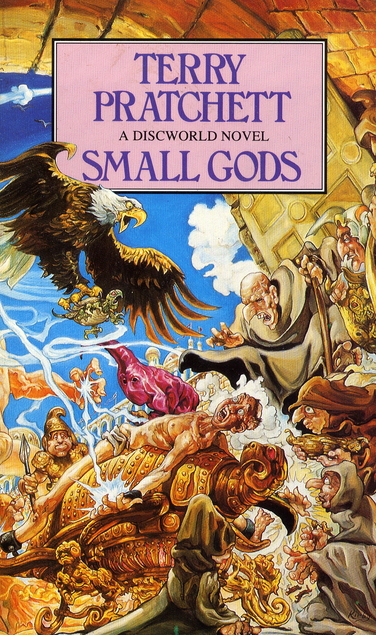
The Great God Om tries to manifest himself once more in the world, as the time of his Eighth Prophet is nigh. He is surprised, however, when he finds himself in the body of a tortoise, stripped of his divine powers, except for the ability to singe eyebrows with tiny thunderbolts.
In the gardens of Omnia’s capital of Kom, he addresses the novice Brutha, the only one able to hear his voice. Om has a hard time convincing the boy of his godliness, as Brutha is convinced that Om can do anything he wants, and would not want to appear as a tortoise.
Brutha is gifted with an eidetic memory and is therefore chosen by Vorbis, the head of the Quisition, to accompany him on a diplomatic mission to Ephebe as his secretary. However, Brutha is also considered unintelligent, since he never learned to read, and rarely thinks for himself. This begins to change after Brutha discovers Ephebe’s philosophers; the idea of people entertaining ideas they are not certain they believe or even understand, let alone starting fistfights over them, is an entirely new concept to him.
With the help of Ephebe’s Great Library, and the philosophers Didactylos and his nephew Urn, Om learns that Brutha is his only genuine believer. All others either just fear the Quisition’s wrath or go along with the church out of habit. After learning that Vorbis had facilitated the death of the missionary Brother Murduck to cover up his being mocked by Ephebian citizenry and to provide a casus belli for war against Ephebe, Brutha uses his memory to reluctantly aid an Omnian raid through the Labyrinth guarding the Tyrant’s palace. Because of his authorship of De Chelonian Mobile (The Turtle Moves), which contradicts Omnian dogma about the shape of the Discworld, Didactylos is brought before Vorbis to face reprisal. However, seemingly conceding his previous views about the shape of the world and willing to write a retraction extolling Omnian interpretations, Didactylos escapes after hitting Vorbis with his lantern. Ordered by Vorbis to burn down the Library, Brutha memorizes many scrolls in order to protect Ephebian knowledge as Didactylos sets fire to the building to stop Vorbis reading its scrolls. Completely unrelated to the story, the Librarian of the Unseen University travels through L-Space to rescue several of the abandoned scrolls.
Fleeing the ensuing struggle in Urn’s steam-powered boat, which is destroyed as the price for an earlier deal made between Om and the Sea Queen, Brutha and Om end up washed up on the desert coast. Trekking home to Omnia with a catatonic Vorbis, they encounter ruined temples dedicated to long-dead, long-forgotten gods, the faint ghost-like small gods yearning to be believed in to become powerful, the small-god-worshipping anchorite St Ungulant, and the human cost of Vorbis’s plan of leaving caches of water in the desert to attack Ephebe. Realising his ‘mortality’ and how important his believers are to him, Om begins to care about them for the first time.
While Brutha, Vorbis, and Om are in the desert, the Tyrant of Ephebe manages to regain control of the city and contacts other nations who have been troubled by Omnia’s imperialistic ambitions. Sergeant Simony, whose native Istanzia had been conquered by Omnia in his youth, brings Didactylos and Urn to Omnia to lead the Turtle Movement in a rebellion against the Church. However, Didactylos asserts that De Chelonian Mobile was meant to be a statement of facts rather than a revolutionary text.
On the desert’s edge, a recovered Vorbis attempts to finish off Om’s tortoise form (killing an ordinary tortoise by happenchance instead), knocks out and abducts Brutha, and proceeds to become ordained as the Eighth Prophet, elevating Brutha to archbishop to buy his silence. After Urn accidentally activates the hydraulic system which secretly operates the doors of the Great Temple, Brutha interrupts Vorbis’s ordainment. As a result, Brutha is to be publicly burned for heresy while strapped on a heated bronze turtle but Om comes to the rescue, dropping from an eagle’s claws onto Vorbis’ head, killing him. As a great crowd witnesses this miracle they come to believe in Om and he becomes powerful again. In the ethereal desert, Vorbis learns to his horror that what he thought was the voice of Om was in fact his own voice echoing inside of his own head, plunging him into despair and leaving him unable to cross the desert and face judgement.
Om manifests himself over the citadel and attempts to grant Brutha the honour of establishing the Church’s new doctrines. However, Brutha wishes to establish a ‘constitutional religion’ whereby Om Himself obeys Omnianism’s new commandments and answers some of the prayers of his followers in exchange for a steady source of belief, believing that Om will lose his power again otherwise.
Meanwhile, Ephebe has gained the support of several other nations along the Klatchian coast and has sent an army against Omnia, establishing a beachhead near the citadel. Brutha attempts to establish diplomatic contact with the generals of the opposing army, wishing to stop the war and subsequent retaliation before it starts by surrendering and offering numerous concessions. Despite trusting Brutha, the leaders state they do not trust Omnia and that bloodshed is necessary. At the same time, Simony leads the Omnian military including Urn’s ‘Iron Turtle’ war engine to the beachhead in order to fight the anti-Omnian alliance.
While the fighting occurs on the beachhead, Om attempts to physically intervene, but Brutha demands he not interfere with the actions of humans. Om becomes infuriated but obeys Brutha, instead travelling to Dunmanifestin, where gods gamble on the lives of humans in order to gain or lose belief. While there, Om manages to unleash his fury, striking other gods and causing a storm that disrupts the battle. Eventually, he compels all other gods of the forces at the battle to tell their soldiers to stop fighting and make peace.
In the book’s conclusion Brutha becomes the Eighth Prophet, ending the Quisition’s practice of torture and reforming the church to be more open-minded and humanist (after Brutha appoints Simony as the new Head Exquisitor and Didactylos as a bishop), with the citadel becoming home to the largest non-magical library on the Discworld. Om also agrees to forsake the smiting of Omnian citizens for at least a hundred years. The last moments of the book see Brutha’s death a hundred years to the day after Om’s return to power, and his journey across the ethereal desert towards judgement, guiding the spirit of Vorbis whom he found still in the desert and upon whom he took pity. It is also revealed that this century of peace was originally meant to be a century of war and bloodshed which the History Monk Lu-Tze changed to something he liked better.
Quotes
- Gravity is a habit that is hard to shake off.
- When people say “It is written…” it is written here. There are fewer metaphors around than people think.
- The unfortunate case of the 59th Abbot, who made a million dollars in small bets before his fellow monks caught up with him.
- “I’ve got my fingers in my ears!” “Suits you. Suits you. Makes you look like a vase. Now—”
- “How many talking tortoises have you met?” it said sarcastically.
“I don’t know,” said Brutha.
“What d’you mean, you don’t know?”
“Well, they might all talk,” said Brutha conscientiously, demonstrating the very personal kind of logic that got him Extra Melons. “They just might not say anything when I’m there.” - Nhumrod looked around the garden. It seemed to be full of melons and pumpkins and cucumbers. He shuddered. “Lots of cold water, that’s the thing,” he said. “Lots and lots.”
- He picked it up and examined it carefully, turning it over and over in his hands. Then he looked around the walled garden until he found a spot in full sunshine, and put the reptile down, on its back. After a moment’s thought he took a couple of pebbles from one of the vegetable beds and wedged them under the shell so that the creature’s movement wouldn’t tip it over.
- He says ‘ow!’ but I think it’s only because he wants to show he’s willing.
- Two bags of sugared dates for the price of one, how about it? And that’s cutting my own hand off.”
- you can count them on the fingers of one head.
- “Going to teach it to do tricks, then?” said Dhblah cheerfully. “Look through hoops, that kind of thing?”
- One of the goddesses had been having some very serious trouble with her dress, Brutha noticed; if Brother Nhumrod had been present, he would have had to hurry off for some very serious lying down.
- Goddess of Negotiable Affection,”
- We think, therefore we am.” “Are,” said the luckless paradox manufacturer automatically. Xeno spun around. “I’ve just about had it up to here with you, Ibid!” he roared. He turned back to Brutha. “We are, therefore we am,” he said confidently. “That’s it.”
- Cosmic speculation about whether gods really exist. Next thing, there’s a bolt of lightning through the roof with a note wrapped around it saying ‘Yes, we do’ and a pair of sandals with smoke coming out. That sort of thing, it takes all the interest out of metaphysical speculation.”
- This milk ought to be allowed to vote.”
- “You gave her ‘It’s always darkest before dawn.’”
“Nothing wrong with that. Damn good philosophy.”
“She said she didn’t feel any better. Anyway, she said she’d stayed up all night because of her bad leg and it was actually quite light just before dawn, so it wasn’t true. And her leg still dropped off. So I gave her part exchange on ‘Still, it does you good to laugh.’” - “Orinjcrates’ On the Nature of Plants,” said Didactylos. “Six hundred plants and their uses…”
“They’re beautiful,” whispered Brutha.
“Yes, that is one of the uses of plants,” said Didactylos. “And one which old Orinjcrates neglected to notice, too. Well done. - People start out believing in the god and end up believing in the structure.”
- Around the Godde there forms a Shelle of prayers and Ceremonies and Buildings and Priestes and Authority, until at Last the Godde Dies. Ande this maye notte be notice
- There is no royal road to learning, sire,’ and he said to me, ‘Bloody well build one or I shall have your legs chopped off.
- The third slave stuck a six-inch dagger in his ear. Then after the revolution the new ruler let me out of prison and said I could leave the country if I promised not to think of anything on the way to the border.
- The captain stared down. The crew was assembling on deck, looking up at him with anxious eyes.
He looked down further. In front of the crew the ship’s rats had assembled. There was a tiny robed shape in front of them.
It said, SQUEAK.
He thought: even rats have a Death… - The Ephebians had been very interested in astronomy. Expletius had proved that the Disc was ten thousand miles across. Febrius, who’d stationed slaves with quick reactions and carrying voices all across the country at dawn, had proved that light traveled at about the same speed as sound. And Didactylos had reasoned that, in that case, in order to pass between the elephants, the sun had to travel at least thirty-five thousand miles in its orbit every day or, to put it another way, twice as fast as its own light. Which meant that mostly you could only ever see where the sun had been, except twice every day when it caught up with itself, and this meant that the whole sun was a faster-than-light particle, a tachyon or, as Didactylos put it, a bugger.
- Humans have always wasted handy protein ever since they started wondering who had lived in it.
References
- Lu-Tze is probably meant to parallel Lao-Tze, the writer of the Tao Te Ching and thus one of the founders of Taoism. The mountain range he carries with him is reminiscent of stories told by and of Taoist and Buddhist sages.
- “‘Young fellow called Ossory, wasn’t there?'” For what it’s worth: an ossuary is a place where the bones of the dead are kept.
- Brother Nhumrod Can refer both to being a nimrod, having a numb rob, and the biblical “Nimrod”.
- “De Chelonian Mobile […] The Turtle Moves.” This whole theory parodies Galileo Galilei’s struggle to get his theory of a moving earth (moving around the sun, that is) accepted by the Christian Church. The specific phrasing of the motto refers to what Galileo supposedly uttered under his breath after recanting his theory to the Inquisition (mirrored by Didactylos having to do the same in front of Vorbis); “E pur si muove” — “And yet it moves”. This explains why the Chelonists say “The Turtle Moves” and not, say, “It’s A Turtle” or “We’re On A Turtle”. After all, the point of contention is the existence of the turtle, not whether it’s mobile or stationary.
- “‘I was beginning to think I was a tortoise dreaming about being a god.'” “Once Chuang Chou dreamt he was a butterfly, a butterfly flitting and fluttering around, happy with himself and doing as he pleased. He didn’t know he was Chuang Chou. Suddenly he woke up, and there he was, solid and unmistakable Chuang Chou. But he didn’t know if he was Chuang Chou who had dreamt he was a butterfly, or a butterfly dreaming he was Chuang Chou.”
- Ego-Video Liber Deorum here as Gods: A Spotter’s Guide. Actually, the dog-Latin translates more literally to The I-Spy Book of Gods. I-Spy books are little books for children with lists of things to look out for. When you see one of these things you tick a box and get some points. When you get enough points you can send off for a badge. They have titles like The I-Spy Book of Birds and The I-Spy Book of Cars.
- “[…] putting a thirty-foot parabolic reflector on a high place to shoot the rays of the sun at an enemy’s ships […]” Legend goes that Archimedes did both of these things!
- “‘Fedecks the Messenger of the Gods, one of the all-time greats,’ said Xeno.” Federal Express (or FedEx) is an overnight shipping courier service.
- Didactylos besides having the word ‘didactic’ as its root (very appropriate for a philosopher), also translates as ‘Two-fingers’. The origin of this rude gesture is supposed to date back to the battle of Agincourt. In those days the French used to cut the index and middle fingers off the right hands of any British archers they happened to catch, in order to render them useless for further shooting should they e.g. ever manage to escape and re-join their army. When the English finally won the battle (largely thanks to their longbowmen) the gesture quickly evolved from a Frenchmen-ridiculing “look what I still got” statement into a more general rudeness.
- Urn: Question: “What’s a Greek urn?” Answer: “About £2,50 an hour!”
- “The Library of Ephebe was — before it burned down — the second biggest on the Disc.” Refers of course to our world’s Alexandrian Library. Brewer tells us that this Library was supposed to have contained 700,000 volumes. It was already burned and partially consumed in 391, but when the city fell into the hands of the calif Omar, in 642, the Arabs found books sufficient to “heat the baths of the city for six months”. Legend has it that Omar ordered the Library torched because all the books in it either agreed with the Koran, and were therefore superfluous; or else disagreed with the Koran, and were therefore heretical, but this is probably just apocryphal. Other references say that the inhabitants of Alexandria torched the scrolls themselves in order to keep the knowledge out of the hands of the Arabs.
- “‘Describe what an Ambiguous Puzuma looks like,’ he demanded.” Brutha goes on to describe the Puzuma as having its ears laid flat against its head. Of course, as we learned in the footnote on p. 178 of Pyramids, in a Puzuma’s “natural state”, everything is laid flat against everything else…
- “‘And the wrong sort of ash’, said Vorbis.” The (true) story goes that British Rail was having difficulty one winter getting trains to run on time, which they blamed on the snow. They were then quizzed as to why their snow ploughs could not deal with the problem. They replied that it was “the wrong sort of snow”, a phrase that has now entered the English idiom.
- “‘Something that’d open the valve if there was too much steam. I think I could do something with a pair of revolving balls.'” The contraption with revolving balls Urn is thinking of in the sentence quoted above was identified by several readers as something called a speed governor, invented by James Watt. This consists of two balls spinning on two opposite movable arms around a rotating central axis. When the centrifugal force gets large enough to lift the balls up, the movement opens a safety valve that lets off the steam, causing the rotation to slow down and the balls to come down again, closing the valve, etc. — a simple but ingenious negative feedback device.
- “There was a city once […] there were canals, and gardens. There was a lake. They had floating gardens on the lake,[…]. Great pyramid temples that reached to the sky. Thousands were sacrificed.” This description evokes Tenochtitlan (now Mexico City), the capital of the ancient Aztec Empire. Tenochtitlan was built on islands in a lake (now drained) and was crossed by canals, and the floating gardens may still be seen, as may the ruins of the pyramid temples on which thousands were indeed sacrificed.
- “Like many early thinkers, the Ephebians believed that thoughts originated in the heart, and that the brain was merely a device to cool the blood.” In our world this idea was originally proposed by none other than Aristotle. Aristotle got almost everything to do with natural history dead wrong, although in his defence it must be said that it was not his fault that later cultures took his works to be Absolute Truth instead of trying to experiment and find things out for themselves.
- “‘What’ve you got? He’s got an army! You’ve got an army? How many divisions have you got?'” As the Allies in World War II were planning the landing in Italy, they had frequent meetings to discuss methods and consequences. On one of these meetings, Churchill made a reference to what the Pope would think about all this. To which Stalin replied, “The pope? How many divisions does he have?”.
- “[…] plunged his beak through the brown feathers between the talons, and gripped.” While I agree with Terry that biological correctness shouldn’t stand in the way of a good joke or plot point, I feel it should still be pointed out that the organs Om is presumably aiming for don’t exist in birds. They simply haven’t got the balls.
- “REMIND ME AGAIN, he said, HOW THE LITTLE HORSE-SHAPED ONES MOVE.” Refers back to a joke on p. 12 of Sorcery, where we are told that Death dreads playing symbolic last chess games because “he could never remember how the knight was supposed to move”.
- There is a rumour going round that there was to be a crucifixion scene at the end of this book but that the publishers made Terry take it out. “Crucifixion in Small Gods: this is a familiar thing to me, a DW ‘fact’ that’s gone through several retellings. Nothing’s been taken out of Small Gods, or put in, and there was no pressure to do either.”
Leave a Reply